The 36% Admin Overhead
The number nobody wants to calculate
More than a third of your work week isn't coaching. It's admin.
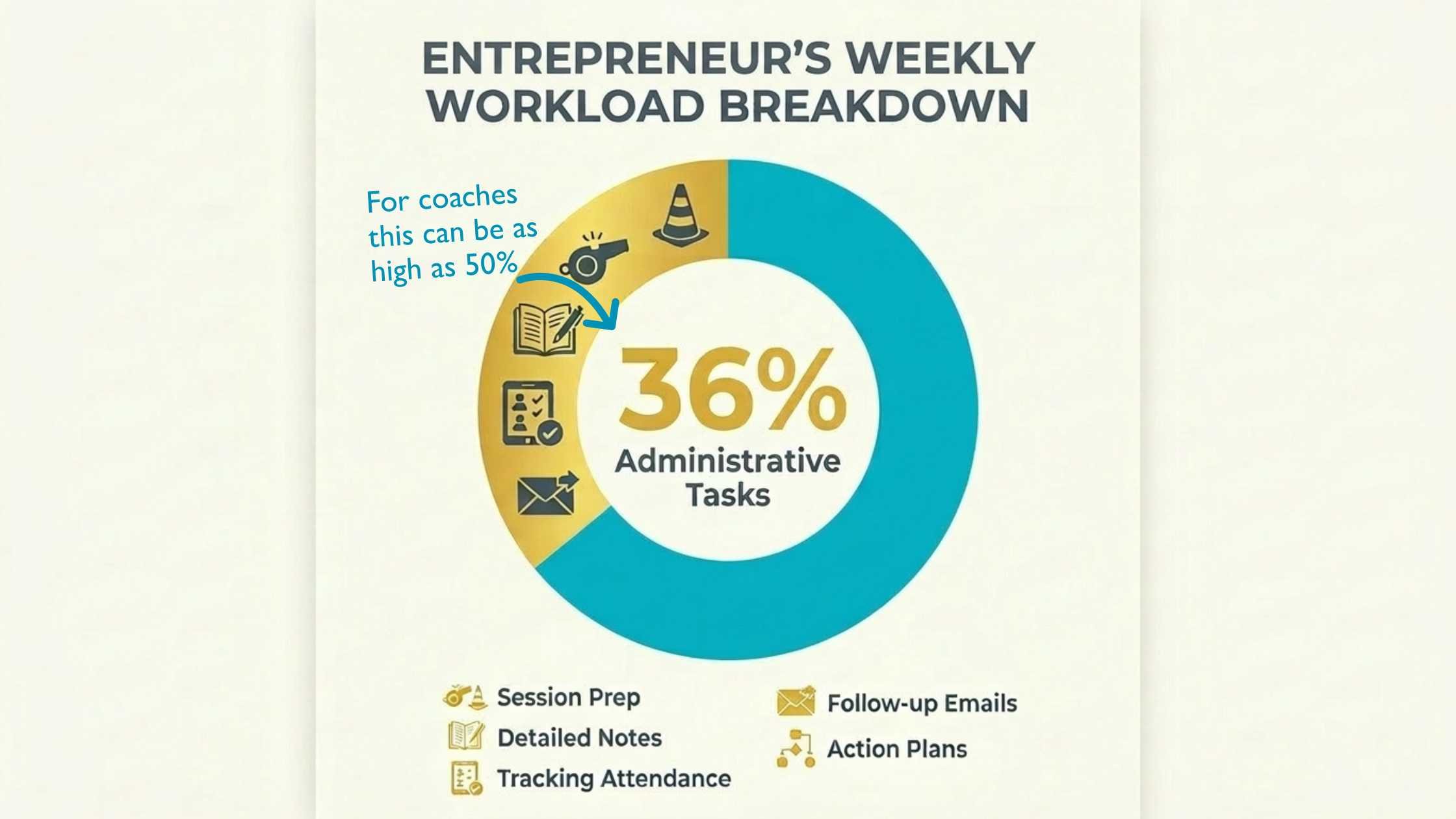
That's not a guess. A 2023 Censuswide survey of 251 U.S. entrepreneurs found that entrepreneurs spend an average of 36% of their work week on administrative tasks. Not strategic planning. Not client work. Not the thing they started their business to do. Admin. Logging expenses, managing schedules, creating invoices, entering data, ordering supplies, chasing details.
And 31% of those surveyed spend between a quarter and half of their entire week on it.
For coaches, it's even more specific. Research from Delenta found that for every 45-minute coaching session, coaches spend an additional 30 to 45 minutes on administrative tasks… session prep, detailed notes, tracking attendance, follow-up emails, action plans. That's nearly a one-to-one ratio. One hour coaching. One hour not coaching.
The same research found that coaches lose an average of 1.25 hours every day on manual tasks like scheduling and invoicing alone.
One coach I spoke with put it plainly: "Having too many different tools is what overwhelms me."
Another said: "It's just another login." All the logins are a major pain-point for her.
The math nobody does
If you're working a 40+ hour week and 36% of that is admin, you're spending somewhere around 15 to 18 hours a week on tasks that don't involve coaching anyone. That's two full workdays. Every week.
And if you're a solopreneur - which most coaches are - there's no team to absorb it. Every tool hiccup, every manual workaround, every "I'll figure it out later" lands on one person. You.
One coach described it as being in "this middle place where I don't quite have enough time myself, but I'm not at a point where I can really invest in... a person." Too busy to keep doing it all manually. Not quite ready to hire help. So you stay in the gap.
That gap is where the 36% lives.
What one piece of content actually costs
I know this math personally. Before starting Sidkik, I spent years as a program manager running teams of eight to ten people. Admin for that team was a full-time job. I thought leaving corporate would mean less overhead, not more.
I was wrong.
As an entrepreneur, the admin didn't go away. It just became mine. All of it. And one of the places it shows up most clearly is content.
Creating a single piece of worthwhile content - a social post, a blog article, a newsletter - takes about an hour when things are going well. That's with tools in place, a cadence figured out, and a process that works. But that hour is just the creation. Before it, there's planning. After it, there's finding imagery, posting to the right platform, engaging with real humans (which is business development and can't be skipped), and then circling back for analytics to understand what worked so you can inform the next one.
You can batch. It helps. But it doesn't save as much as people say it does. It's either sitting down for four or five hours to create a week's content or trying to get a single social post created and out the door in 30 minutes, if you're lucky.
For me, it's five to seven hours a week on content alone. That's the bare minimum. Something bigger like a case study, a lead magnet, a long-form blog like this one… and it's more.
And here's the part that makes the 36% feel personal: my work day gets bookended by my daughter's school schedule. Some days it's an hour of social media, an hour of blog writing, and I only have six hours total before pickup. The work that doesn't fit spills into evenings. Into weekends. What should be a 40-hour week stretches across seven days. And content creation - which is critical, not optional - ends up being a quarter to a third of all of it.
That's the overhead. Not dramatic, but much more than is generally planned for.
Not one crisis. Just relentless.
What we're obsessed with
This is what we think about at Sidkik every single day.
Not just making tools simpler. Removing the overhead. Eliminating the logins. Building something where every piece of the platform knows about every other piece, so you stop losing time translating between systems that don't talk to each other.
Right now, I'm building what we're calling the Content Studio. It's one place where your entire content ecosystem - blog posts, social content, newsletters, lead magnets, and more - gets ideated, created, scheduled, and published. No starting with spreadsheets to plan. No logging into three different platforms to post. No manual tracking what went where and when. And no logging into multiple platforms multiple times to get it all done.
Every piece of thought leadership and expertise you create lives in one ecosystem. The ideation informs the draft. The draft connects to your imagery. The imagery connects to the publish. The publish connects to the analytics. And the analytics inform the next piece of content.
That's not a pitch. That's what happens when you stop accepting the overhead as normal and start asking what it would look like without it.
The question
36% is the average. For coaches… with their session prep, their follow-ups, their content, their scheduling, their invoicing, their "just one more login"... it might be higher.
What would you do with a third of your week back?
Not someday. Not when you hire help. Not when things calm down.
What would you actually do with that time?